- Introduction & Background
- Posstack: Are there specific bundle structures (e.g. mix-and-match, BOGO, quantity breaks, etc.) that perform better in certain niches, for instance, Apparel, Beauty & Fitness, Home & Garden?
- Posstack: What are the top 3 bundling mistakes you see Shopify stores make that kill conversions, and how can they avoid them?
- Posstack: Where in the customer journey should bundles be introduced for maximum impact? What's the ideal way to present bundles on PDPs vs. cart vs. checkout without overwhelming customers?
- Posstack: Beyond placement, what promotional strategies or messaging tactics actually get customers to notice and click on bundle offers?
- Posstack: How do post-purchase bundle offers differ from pre-purchase ones in terms of structure and messaging? What makes them convert?
- Posstack: What specific bundle elements should stores test first (pricing, presentation, product combinations)? What metrics matter most? How do you balance bundle discounts to make them attractive without eroding margins?
- Posstack: Share with me the best 3 bundle examples you've implemented for your clients. Why did they work?
- Posstack: What features separate a good bundle app from a great one? What should stores prioritize based on their size/complexity?
- Posstack: Should bundles be treated as separate SKUs for inventory management? What technical considerations trip up stores?
- Posstack: How does bundling strategy differ for stores with high vs. low average order values?
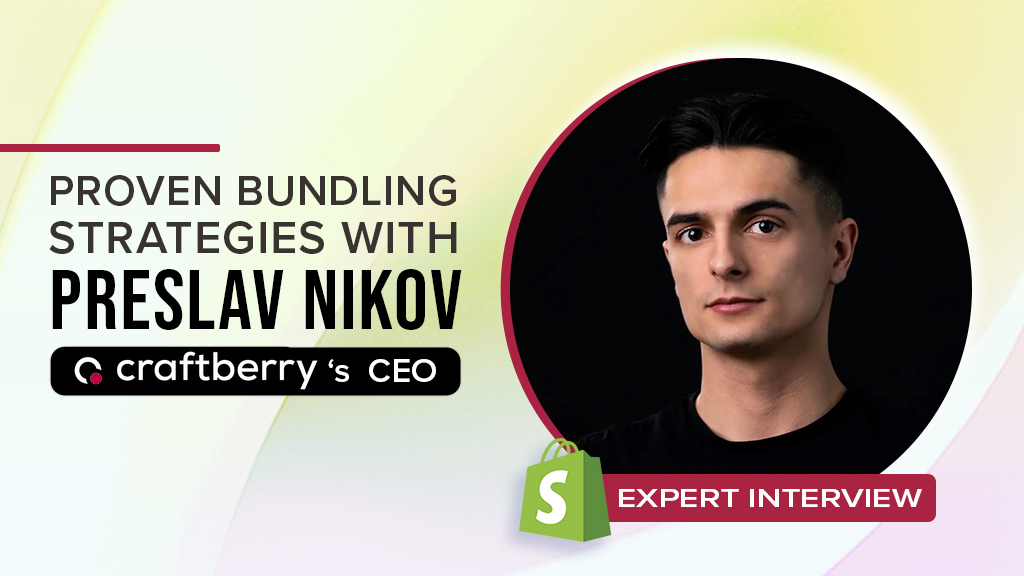
Today, I am excited to have a great talk with Preslav Nikov, Founder and CEO at craftberry - a certified Shopify Plus Partner supporting established eCommerce brands across Europe and beyond.
We dig deep into all areas of product bundling strategies for Shopify and Shopify Plus stores, sharing the best practices Preslav Nikov advises clients to follow, based on his hands-on experience with real-life, complex Shopify projects.
Introduction & Background
Preslav Nikov leads a team of 30+ Shopify specialists covering design, development, and Shopify CRO, working with brands such as On Running, Shelly, and Pepper.
In 2025, Preslav was named to Forbes 30 Under 30 Bulgaria, recognising his role in building and scaling one of the region’s most respected Shopify-focused teams.
His perspective comes from years spent close to complex projects, real commercial decisions, and the realities of scaling modern eCommerce businesses.
Posstack: Are there specific bundle structures (e.g. mix-and-match, BOGO, quantity breaks, etc.) that perform better in certain niches, for instance, Apparel, Beauty & Fitness, Home & Garden?
Preslav Nikov: There isn’t a single “golden rule” for bundling that applies to every industry.
Most bundle structures can work across niches when you align them with customer intent and product logic.
That said, certain formats tend to feel more natural in specific verticals.
- Mix-and-match bundles perform especially well in Beauty and Cosmetics.
- Scenario A: Customers can build their own bundle by choosing the same product in different variants, such as one lipstick in multiple colors. This gives users a sense of control and personalization, which is particularly important in beauty.
- Scenario B: Customers select several different products and receive a bundled discount. You can also combine this method with Buy X, Get Y structure to increase perceived value.
- In the Fitness and Supplements space, we often see brands use bundles to increase lifetime value rather than focusing solely on average order value.
- Subscription-based bundles combined with starter kits or free gifts are especially effective. For example, offering a “starter pack” or a free gift with a subscription encourages long-term commitment and improves CLV.
- Cross-sell bundles are also common, such as pairing whey protein with creatine or vitamins that customers typically consume together.
- BOGO-style offers are widely used in Fashion, Skincare, and Cosmetics.
- These are often structured as “Buy X, Get Y,” where the second item is discounted or free depending on the campaign.
- At craftberry, we frequently introduce tiered BOGO logic, for example:
- Buy one item from a specific collection and get the second at 50% off.
- Buy one, get the second free during high-intent periods like sales or launches.
Posstack: What are the top 3 bundling mistakes you see Shopify stores make that kill conversions, and how can they avoid them?
Preslav Nikov: Every Shopify store is different, and so are the mistakes that come with them. Here are some common bundling pitfalls I've come across:
- Creating irrelevant bundles: One of the most common mistakes is bundling products that don’t logically belong together.
- Instead of offering random combinations, we build successful bundles around a clear customer benefit.
- A strong example in skincare is selling a complete routine for the best result, rather than unrelated products. This gives the customer a solution, not just a discount.
- Instead of offering random combinations, we build successful bundles around a clear customer benefit.
- Poor price logic: Bundles often fail when the pricing feels unrealistic or confusing.
- You need to justify price gaps, especially when you position one product as a core item and the other as an add-on or bonus.
- The discount should feel meaningful but not suspiciously high. Strategic pricing calculations are essential and should be based on margins, perceived value, and average order value.
- Not using data to build bundles: At craftberry, we rely on data when creating bundles.
- Rather than guessing which products work well together, analyze purchase behavior and see what customers already buy in the same order.
Posstack: Where in the customer journey should bundles be introduced for maximum impact? What's the ideal way to present bundles on PDPs vs. cart vs. checkout without overwhelming customers?
Preslav Nikov: From my personal experience bundles tend to perform better for returning customers in most industries we work with.
New customers usually need more confidence, education, and clarity before committing to multiple products at once.
That said, placement still plays a crucial role.
- PDPs are one of the strongest positions for bundles.
- We usually place bundles directly in the buy box, close to the “add to cart” button.
- This placement works because the customer is already in a buying mindset.
- Clear value communication is critical here. We always highlight the savings, the benefit of buying together, and why the bundle makes sense.
- For returning customers, bundles tend to work extremely well on collection pages.
- We often surface bundled products as the first items in the collection grid to anchor value.
- The cart is ideal for contextual upsells.
- At this stage, we focus on complementary products. For example, if a customer adds a bra to the cart, we offer a bundle with matching panties.
- At checkout, we use lightweight bundles.
- We treat checkout bundles as last-minute upsells, similar to cart offers but usually at a lower price point.
Posstack: Beyond placement, what promotional strategies or messaging tactics actually get customers to notice and click on bundle offers?
Preslav Nikov: At craftberry, we treat pre-purchase and post-purchase bundles as two completely different tools.
Post-purchase bundles rely heavily on urgency.
- We usually offer discounted products with a limited-time window immediately after checkout.
Pre-purchase bundles, on the other hand, need to support the buying decision.
- As we discussed earlier, they depend on clear structure, logical product combinations, and strong value communication.
Posstack: How do post-purchase bundle offers differ from pre-purchase ones in terms of structure and messaging? What makes them convert?
Preslav Nikov: Pre-purchase and post-purchase bundles serve different roles in the customer journey, so we approach them differently.
- Pre-purchase bundles focus on helping customers make a buying decision.
As we discussed earlier, they rely on clear structure, logical product combinations, and strong value communication across PDPs, collections, cart, and checkout. - Post-purchase bundles work on momentum. After checkout, customers have already committed, so the messaging shifts toward urgency rather than explanation.
We typically present post-purchase offers as discounted add-ons with a limited-time window.
These offers convert because they feel low-risk and time-bound, not because they require additional decision-making.
The key difference is intent. Pre-purchase bundles reduce friction before the purchase, while post-purchase bundles capitalize on trust and buying momentum after the purchase is complete.
Posstack: What specific bundle elements should stores test first (pricing, presentation, product combinations)? What metrics matter most? How do you balance bundle discounts to make them attractive without eroding margins?
Preslav Nikov: When we test bundles for our clients, we always start with product combinations and pricing, before touching design or messaging.
From a metrics standpoint, the exact KPIs depend on the business model, but we most often track AOV (Average Order Value), RPV (Revenue Per Visitor), CAC (Customer Acquisition Cost).
Balancing discounts requires strict cost control. We calculate cost per unit, advertising costs, fulfillment, and all customer-related expenses.
Only after mapping these numbers do we decide how aggressive the discount can be.
Posstack: Share with me the best 3 bundle examples you've implemented for your clients. Why did they work?
Preslav Nikov:
- One strong example comes from a lingerie brand. We created a mix-and-match bundle for thongs, allowing customers to choose any three styles.
This worked because it combined personalization with a clear value incentive, and customers naturally wanted variety. - Another successful case involved a fashion brand using the BOGO method.
The offer followed a simple structure: buy one item and get the second at 50% off. - A third example comes from an accessory brand. Customers could buy two bags in different colors and receive a third one for free.
The bundle worked because color variation drove desire, and the free item felt like a meaningful reward rather than a small discount.
Across all three cases, the common factor was clarity. Customers instantly understood what they got and why the bundle made sense.
Posstack: What features separate a good bundle app from a great one? What should stores prioritize based on their size/complexity?
Preslav Nikov: Great bundle apps can excel in a few critical areas.
- Clean, intuitive UX
- Stable performance with no bugs
- Advanced customization logic, both in offer rules and UI presentation
- Strong tools for offer communication, such as discount labels, badges, and clear price breakdowns
Posstack: Should bundles be treated as separate SKUs for inventory management? What technical considerations trip up stores?
Preslav Nikov: The short answer is that it depends.
Instead of thinking in terms of a universal rule, we usually encourage merchants to step back and ask a few key questions before deciding how to structure bundles.
- Is this bundle meant to be a long-term, always-on offer or a short-term campaign?
- Do you need the bundle to appear as a standalone product in reports, forecasts, or external systems?
- How closely does bundle availability need to follow real-time stock levels of individual products?
- Are you working with virtual bundles, inventory-linked bundles, or a mix of both?
- How much flexibility do you need to change pricing, composition, or availability over time?
Most technical issues arise when these questions don’t have clear answers upfront.
Inventory syncing, stock accuracy, and reporting problems usually reflect misalignment between business intent and technical setup rather than a flaw in the bundling idea itself.
Posstack: How does bundling strategy differ for stores with high vs. low average order values?
Preslav Nikov: For low AOV stores, bundles play a critical role.
- They help push customers toward higher-value purchases and justify shipping and acquisition costs.
- We often see bundles become a core revenue driver in these cases.
For high AOV stores, the approach changes.
- Instead of forcing aggressive bundles, we analyze what customers already buy together.
- We optimize existing combinations and remove friction rather than pushing large discounts.
In both cases, successful bundling starts with understanding real customer behavior, rather than assumptions.